
The old model is quietly breaking
For years, agencies sold design as output.
Screens. Pages. Components. Delivered on demand, usually through a subscription. It worked when building software was slow, when iteration cycles were expensive, and when most clients needed help just getting something online.
That environment is gone. Today, interfaces can be generated instantly. Layouts are commodities. Even reasonably structured frontends can be assembled without much friction. The constraint is no longer production.
It’s coherence. Clients are not struggling to get designs anymore. They are struggling to turn scattered pieces into something that actually works as a system.


Software is expanding sideways
When building becomes easy, the direction of growth changes.
Instead of going deeper into a single product, companies expand outward. A landing page is not enough. It connects to a dashboard. That dashboard needs documentation. Documentation leads to community. Community feeds back into the product.
What used to be a single surface becomes an ecosystem.
This is already happening across the industry. Tools are blending into each other. Products are absorbing adjacent functionality. Builders are shipping multiple surfaces at once, not because they want to, but because the product requires it.
The problem is not expansion itself. It’s doing it without breaking everything in the process.
The real bottleneck is structure
AI made code cheap. But cheap code does not mean maintainable systems. In fact, it usually means the opposite. More code, more divergence, more edge cases. Things work individually, but fail collectively.
You can generate ten features in a day and still end up with a product that feels inconsistent, fragile, and impossible to extend.
Because what matters is not how fast you can build. It’s whether what you build fits together.
Structure is what compounds. Without it, speed just accelerates entropy.
From deliverables to systems
This is where the service model starts to shift.
Clients don’t need more pages. They need a system that covers everything their product touches:
- Acquisition (landing pages)
- Product experience (apps, dashboards)
- Enablement (documentation)
- Retention (community)
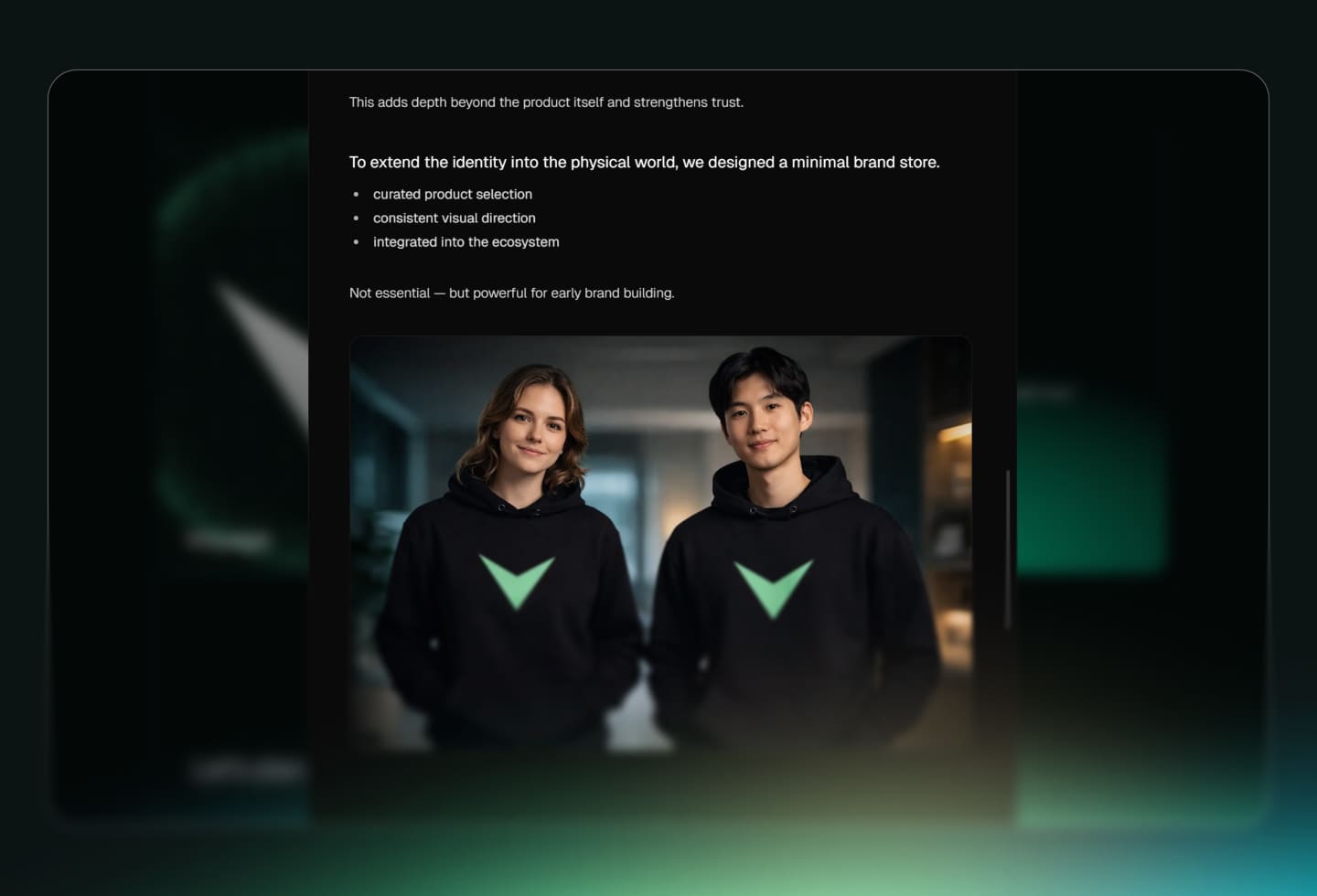
- Trust (branding, founder presence)
Traditionally, these were separate projects. Different timelines. Different tools. Different people.
Now they can be delivered as one cohesive system.
Not as a bundle of files, but as a connected, deployment-ready ecosystem.
What Once UI actually enables
Once UI is not just a design system.
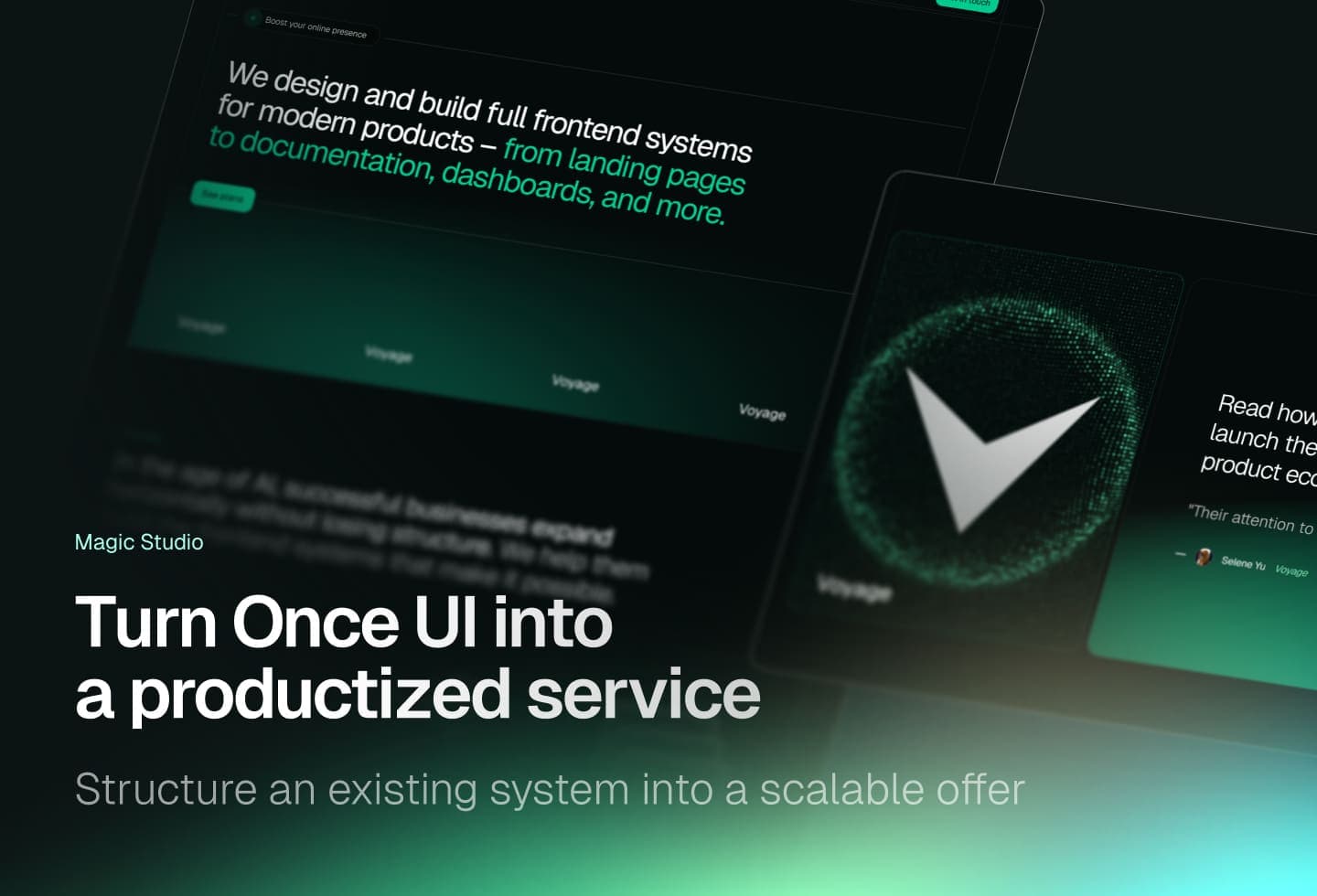
It is a set of production-ready applications that share structure, patterns, and decisions. Each part can stand on its own, but they are designed to work together.
That changes how you deliver work.
You are not starting from zero. You are starting from a system that already encodes:
- layout and interaction patterns
- architectural decisions
- design consistency
- extensible foundations
Instead of designing everything from scratch, you adapt an existing structure to a new context.
That difference is where the leverage comes from.
A new type of offer
When the system is reusable, the service becomes repeatable.
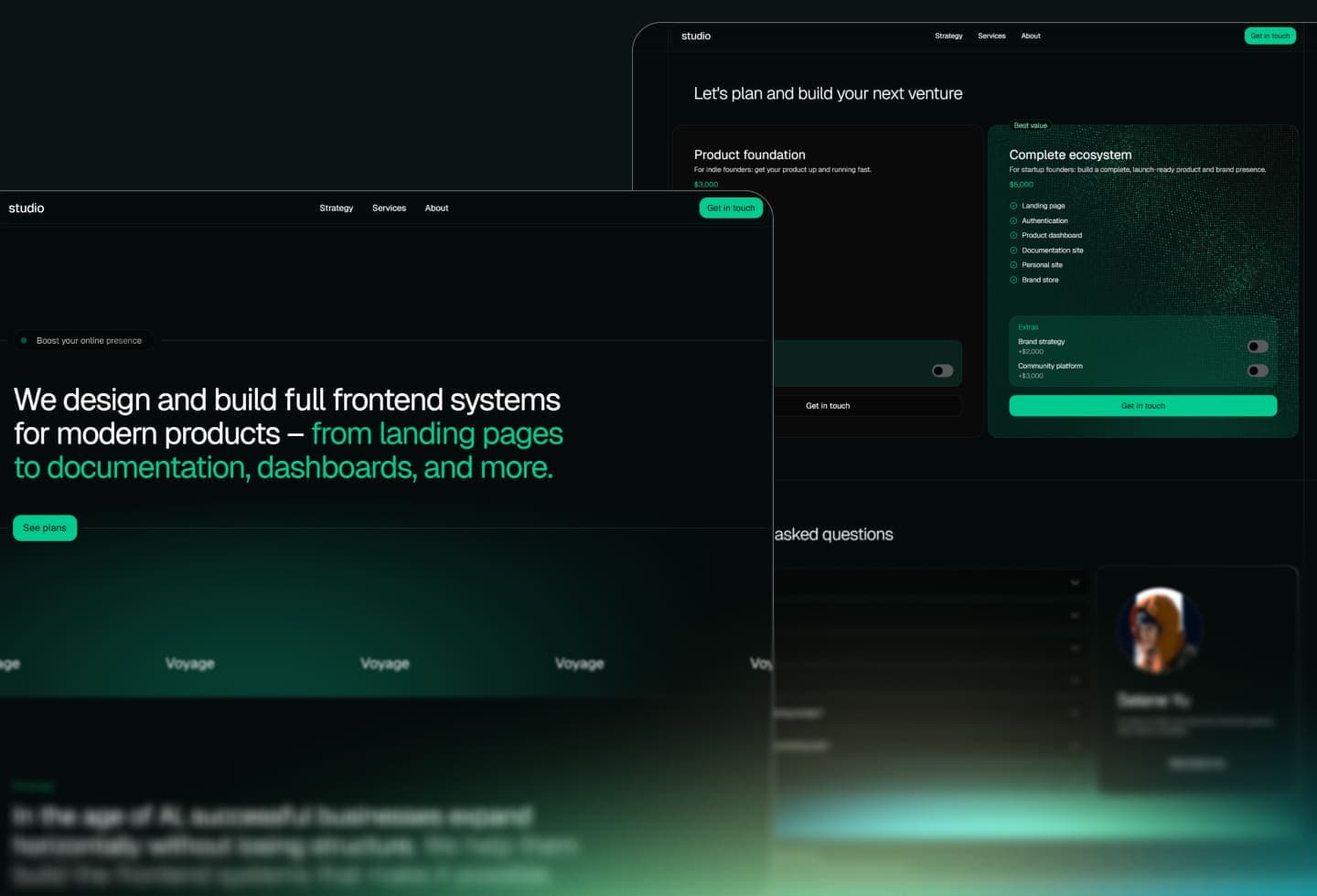
Instead of selling “design” or “development”, you can sell a complete ecosystem as a fixed, high-value offer.
For example:
A studio can deliver:
- landing page
- product interface
- documentation
- community layer
- brand presence
…as a single package.
Not over months, but over days or weeks.
This is not hypothetical pricing. Clients already pay $20k–40k for fragmented versions of this. The difference is that delivery is slow, inconsistent, and difficult to scale.
With a system, the same scope becomes structured. Which means it becomes productizable.
Different ways to use the model
The interesting part is not just the high-end offer.
It’s how flexible the model becomes once you stop thinking in single deliverables.
1. High-value ecosystem delivery
You position yourself as a studio that launches complete product ecosystems.
Not just “we design your app”, but:
"We build your entire frontend surface"
This justifies higher pricing because you are solving a broader problem. You are aligning multiple parts of the business into a single system.
The work feels bigger because it is.
2. Focused productized services
You can also narrow the scope.
Instead of delivering everything, you specialize in one part of the system and productize it:
- portfolio sites for founders
- documentation platforms for SaaS
- internal dashboards
- community layers
Each becomes a repeatable offer with clear boundaries and fast delivery.
The system still exists in the background. You are just exposing one surface of it.
3. Platform specialization
Some builders will go deeper.
Instead of general services, they focus on a specific type of product. For example:
- launching niche social platforms
- building community-driven products
- creating internal hubs for teams
Here, Supa Social or similar templates become the foundation. You are not reinventing infrastructure. You are shaping it for a specific audience.
Over time, this becomes expertise.
And expertise compounds.
Why this model works now
This approach would not have worked a few years ago.
The cost of building was too high. The effort to maintain consistency across multiple surfaces was too large. The systems required too much custom work.
Now, those constraints are gone. What remains is the ability to structure what already exists.
That is the shift:
- From building things to arranging systems.
- From one-off projects to repeatable delivery.
- From output to architecture.
The underlying advantage
Most agencies still operate on a blank canvas.
Every new client resets the process. New designs. New decisions. New inconsistencies. Even when the work looks polished, it does not compound.
A system changes that dynamic: each delivery reinforces the next. Patterns stabilize. Decisions are reused. The service becomes faster without becoming chaotic.
You are not just delivering work. You are operating a system that produces it.
Where this leads
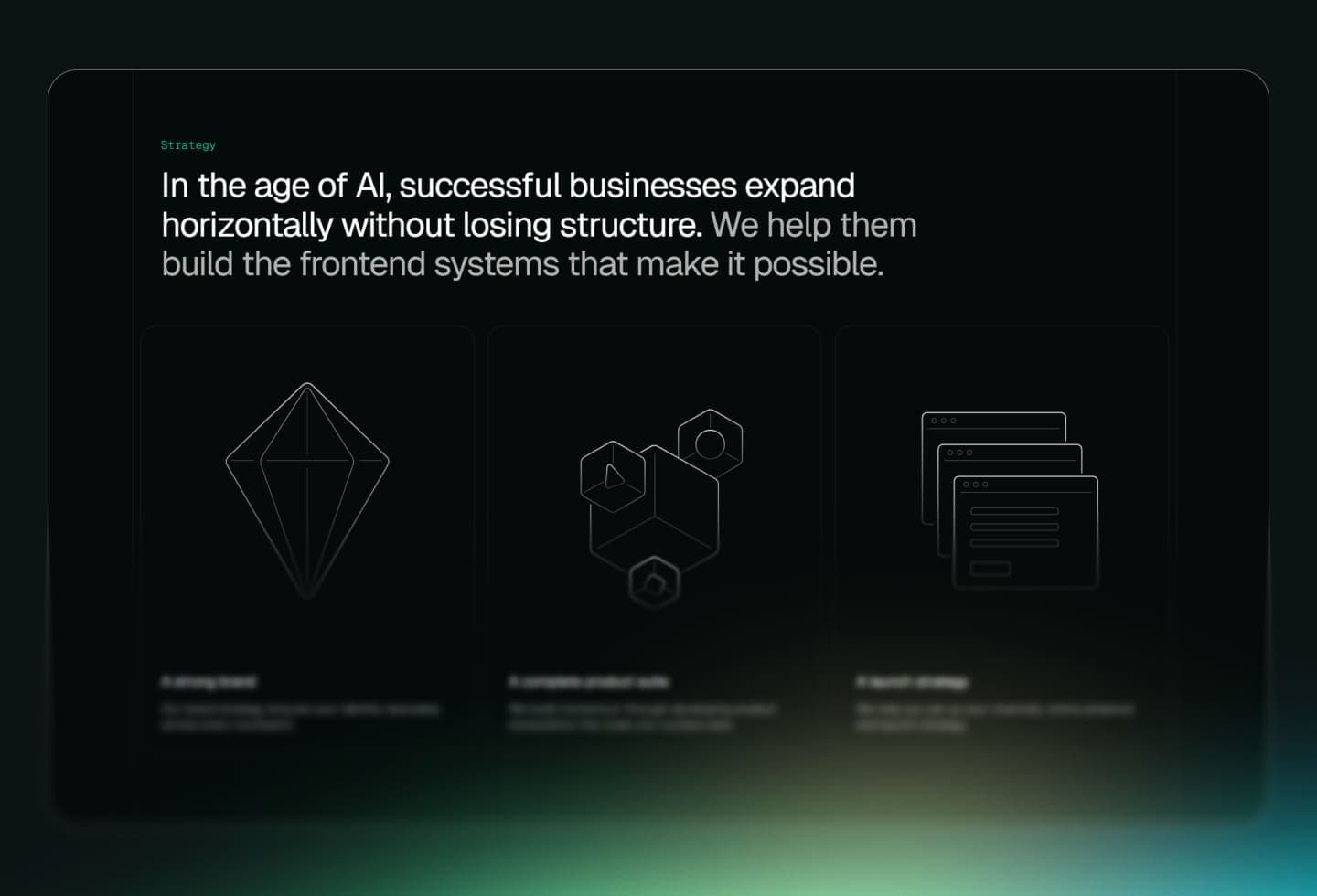
As software continues to expand horizontally, this model becomes more relevant. More surfaces. More expectations. More need for coherence.
The builders who win are not the ones who can generate the most code. They are the ones who can keep everything aligned as it grows.
That requires structure.
And structure is something you don’t improvise on every project. You build it once, then you deliver it repeatedly.
Turn this into your own service
Everything described here is already structured.
Magic Studio is a ready-made system for launching your own productized service on top of Once UI. It includes the templates, the building blocks, and the offer structure — so you don’t have to piece it together yourself.
You’re not starting from scratch.
You’re starting from a system you can adapt and deliver repeatedly.
You’re starting from a system you can adapt and deliver repeatedly.
Design Engineers WeeklyLearn about design, development and business