Long-form writing needs a different medium
Most writing on the internet is optimized for scanning: short paragraphs, quick headings, minimal commitment.
It makes sense in a feed-driven environment, where attention is fragmented, and context switches are constant. The goal is not immersion, but retention.
Long-form writing operates differently.
Novels, essays, and journals are not meant to be consumed in fragments. They require continuity. They require presence. They require a medium that supports depth rather than interrupting it.
The problem is that most tools for publishing are built for distribution, not experience.
- Blogs prioritize structure over flow.
- Docs prioritize clarity over atmosphere.
- Social platforms prioritize engagement over meaning.
None of them are designed for sustained reading.


A project that started as a personal experiment
Magic Journal did not begin as a product.
It began as an experiment while working on my own novel, Journal of the Universe.
The initial question was simple:
What would a reading experience look like if it was designed intentionally for immersion?
What would a reading experience look like if it was designed intentionally for immersion?
Instead of adapting writing to existing formats, I started adapting the format to the writing.
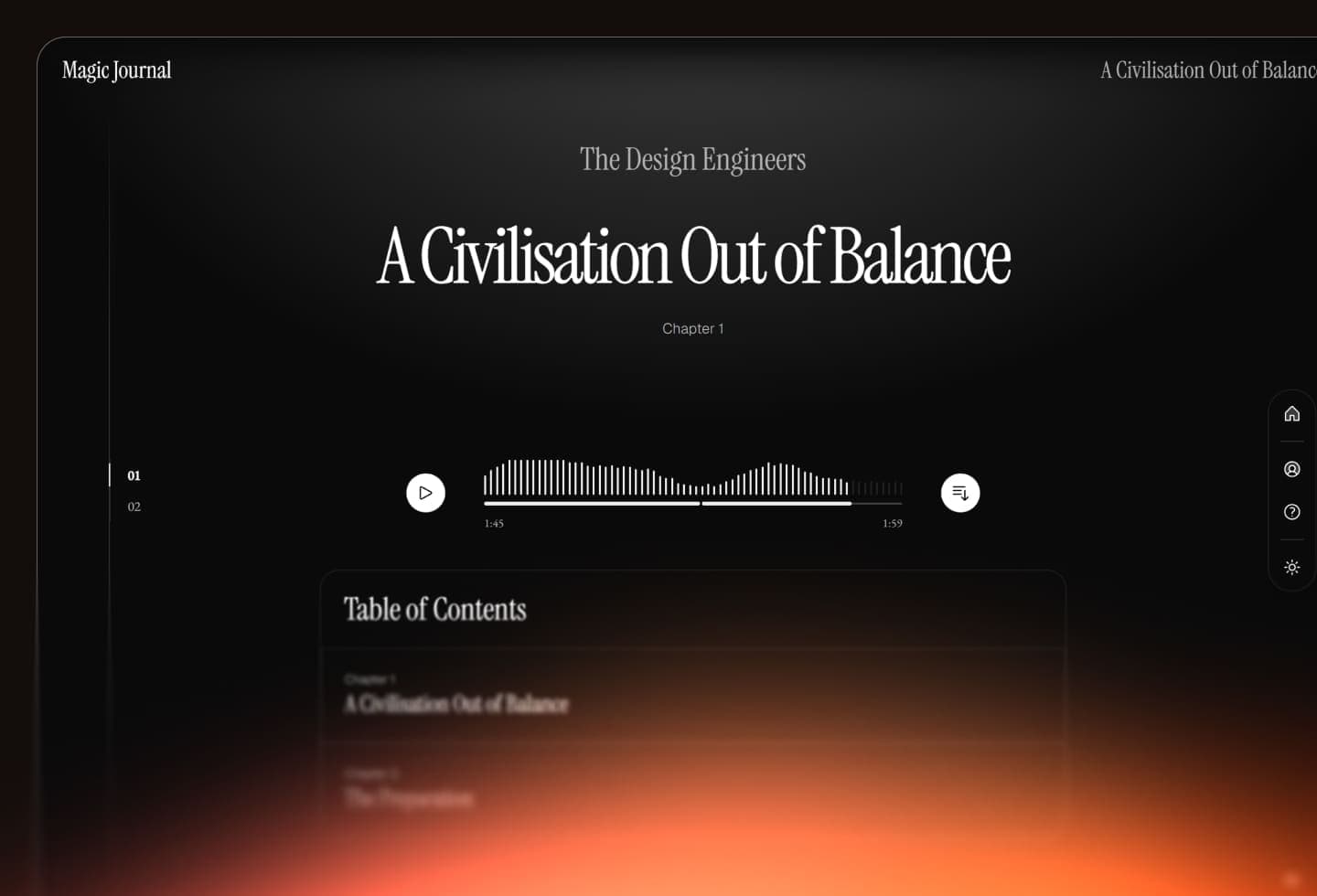
Features emerged from that process:
- Auto-scrolling to maintain flow
- Text highlighting for continuity
- Transcription support for accessibility and alternative consumption
None of these were meant as “features” in the traditional sense. They were attempts to remove friction between the reader and the text.
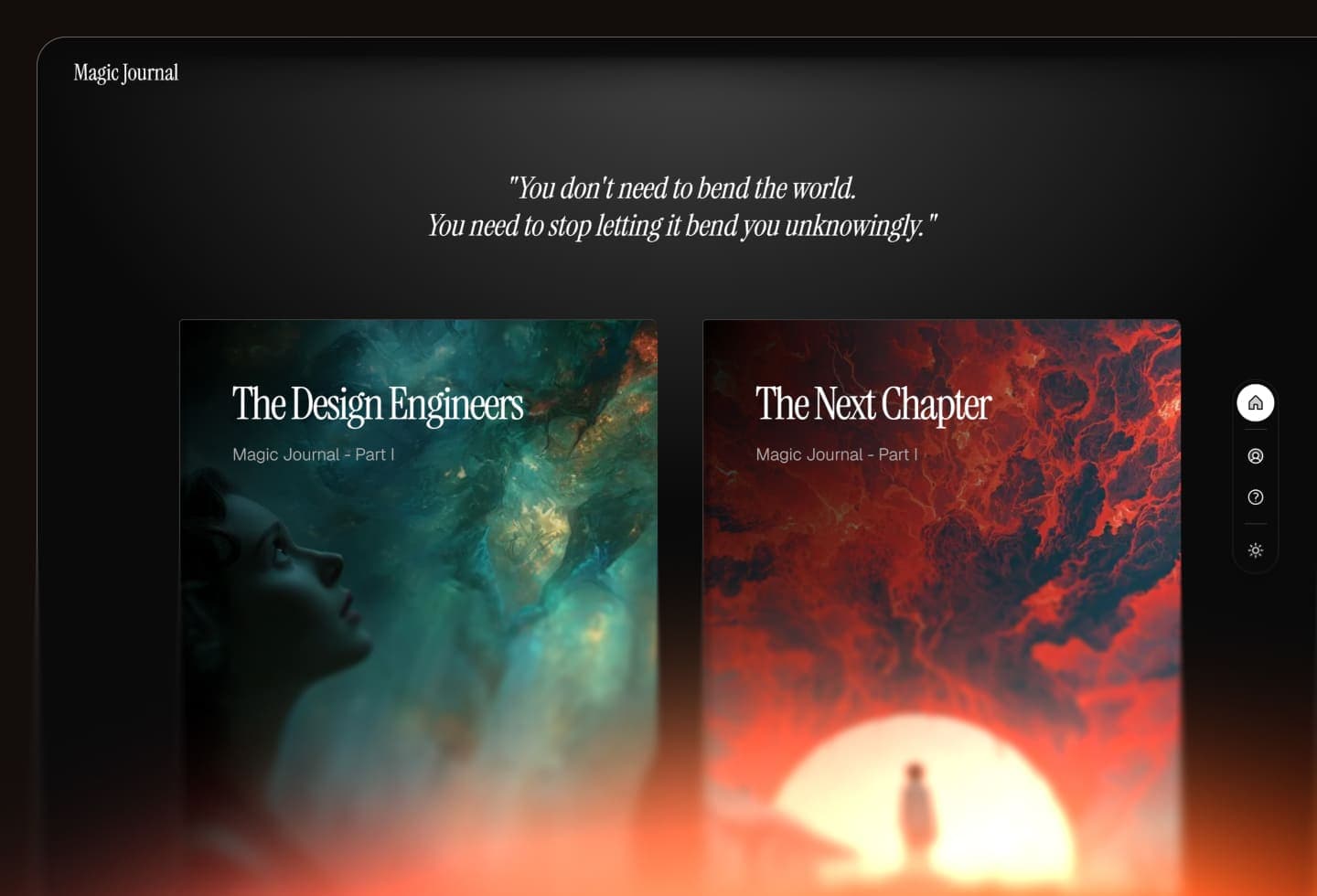
Over time, this experiment evolved into a small application. A unique reading environment.
Structure over presentation
As with other Magic templates, the goal was not to create a visual style. It was to define a structure.
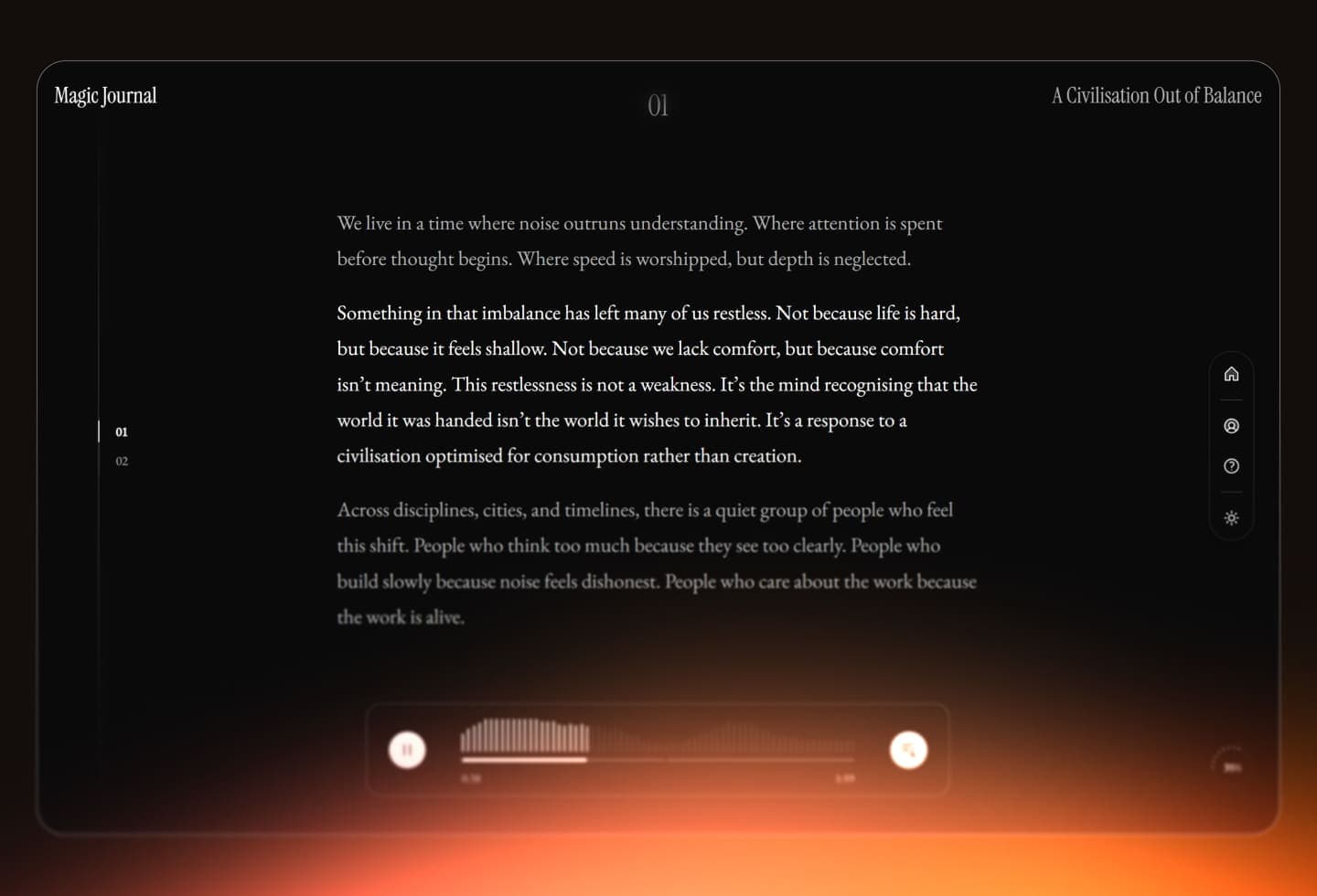
Magic Journal is not just a page layout. It is a system for organizing long-form content:
- Chapters instead of posts
- Flow instead of fragmentation
- Continuity instead of navigation-first thinking
The interface stays minimal on purpose.
Typography carries the experience, spacing defines rhythm, and interaction stays secondary to content.
The result is something closer to a medium than a template.
Not everything needs to scale horizontally
Most of our work focuses on horizontal expansion: landing pages, dashboards, documentation systems, community platforms.
These are systems that grow outward, connect, and compound.
Magic Journal moves in the opposite direction: it narrows the scope, removes surface area, and prioritizes depth over expansion.
This is intentional.
Not every project benefits from more features, more pages, or more integration. Some benefit from reducing everything to a single continuous experience.
A niche by design
Magic Journal is not meant for everyone.
It is not optimized for marketing or rapid content production. It exists for a specific type of project:
- Novels
- Long-form essays
- Personal journals
- Narrative-driven content
Projects where the experience of reading matters as much as the content itself.
From experiment to template
The project was almost complete, but it was never a priority.
Other parts of Once UI required more attention as the system expanded. New templates were introduced and my project that became the skeleton of Magic Journal remained in the background. But leaving it unfinished did not feel right.
So instead of letting it fade, I polished it, structured it, and released it as a Magic template.
It's not a flagship product, just an exceptionally designed tool for those who need it.
A different kind of starting point
Magic Journal is now available for Indie and Pro members.
Now it's your turn to extend, reshape and remix it.
You can launch it as-is, or build something entirely different on top of it.
But the core idea remains: long-form writing deserves a medium designed for immersion. Magic Journal is one possible answer to that.
Design Engineers WeeklyLearn about design, development and business