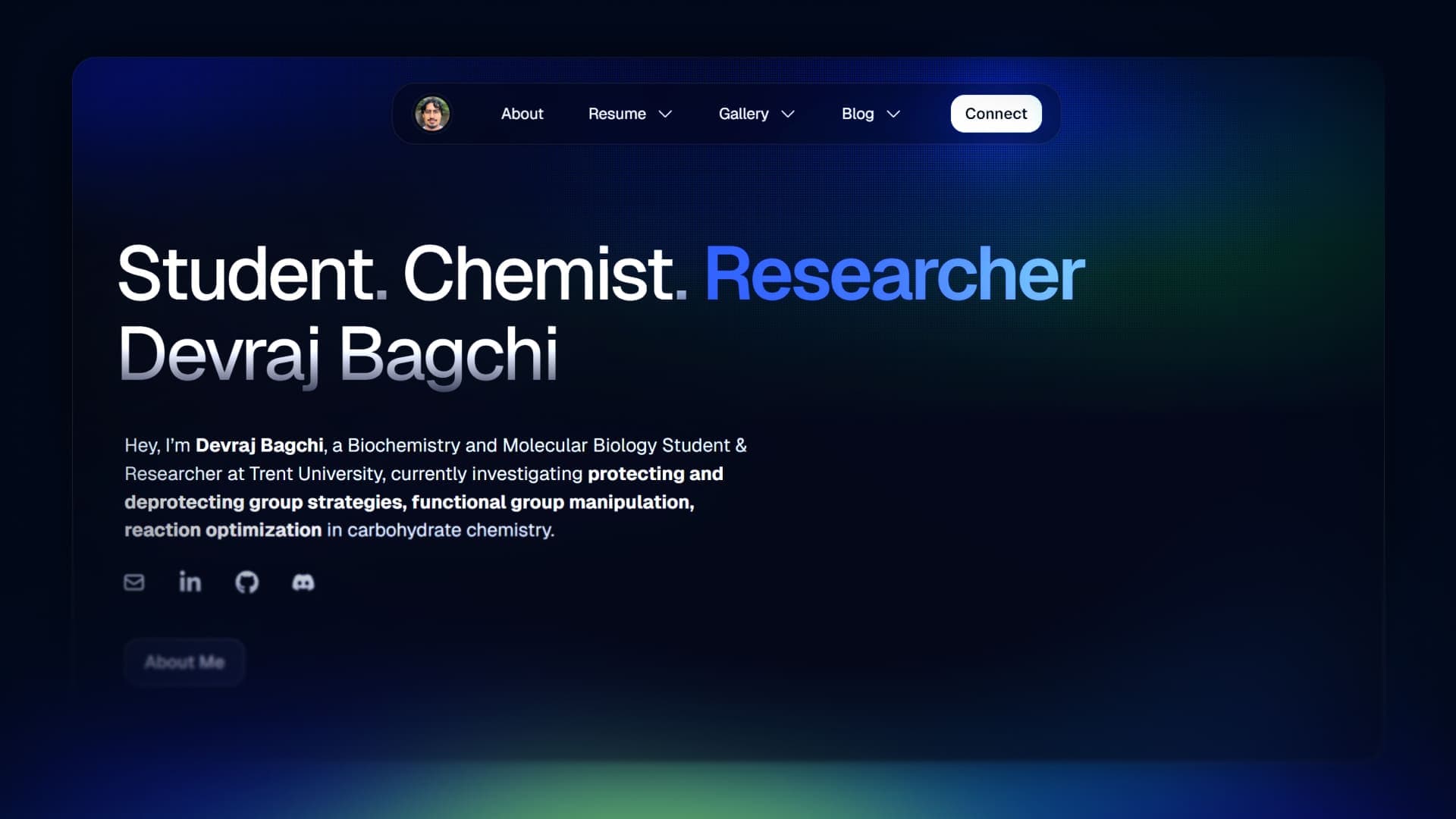
Dev is a chemistry student who turned to coding to share his journey and organize his research.
Can you tell us about your journey?
Hi, my name is Devraj (you can call me Dev), and I’m an aspiring medicinal and pharmaceutical chemist. I’m in my final year of a B.Sc. in Biochemistry and Molecular Biology. My goal is to gain industry experience in different areas of applied chemistry before going to graduate school for further research.
Funny enough, chemistry wasn’t always my passion. I entered this program as a pre-med track, just trying to tick off requirements. Early in my degree, I did well academically. But when in-person classes returned after COVID, things got hard — my mental and physical health declined, grades suffered, and I often felt isolated from peers and professors.
Organic chemistry was the worst. I failed it twice, and one more failure would have ended my program. Then, during a summer term, I had a professor who not only taught well but actually listened and supported me. I earned a B — one of my highest chemistry grades at the time — and that experience planted a seed of genuine appreciation for organic chemistry.
The real turning point came in my third year. I met my current supervisor, who invested countless hours in helping me understand advanced organic chemistry. She once reviewed assignments with me over Zoom while I was on a noisy GO bus (never again). I worked hard but still earned a C in her course. For the first time, I cried over a grade — not because of the grade itself, but because I felt I had let down someone who believed in me.
Motivated to improve, I kept going. In the next semester, I earned an A+ and have since excelled in higher-level chemistry courses. Through her mentorship, I developed not just skills but a real passion for organic chemistry — and I finally felt truly valued.
Now, as I enter my final year, my focus is on raising my GPA and preparing for the next chapter: applying my skills in industry and eventually pursuing research in medicinal chemistry.
How did coding enter the picture?
In the middle of my degree, I faced a year of unemployment despite improving my academics. I wanted to stay productive, so I started Reaction Repo, a personal project combining my interest in chemistry with web development.
The goal was simple: create an organized, accessible resource for reaction mechanisms and research — useful for myself and others. It became a study tool and a way to demonstrate initiative. It’s far from complete but continues to grow.
At the same time, I built a personal portfolio website to showcase my journey as a chemist — my lab techniques, apparatus, and projects. One thing I’m especially proud of is that when someone searches my name, they see more than a LinkedIn profile — they see tangible evidence of my skills and growth. That makes me feel like a more complete, authentic professional.
“Coding hasn’t changed how I solve chemistry problems. But it’s made me a better communicator and more resourceful.”—Devraj
What did Once UI do for you?
Once UI made building much less intimidating. The clarity of the helped me get started with confidence. I loved the flexibility of the framework — the structure, color schemes, and components are highly customizable. That meant I could create layouts that matched the professional tone I wanted for my portfolio.
Beyond the product, the community was invaluable. It’s active and supportive — a huge contrast to many other platforms I’ve used. That kind of engagement makes the difference between feeling stuck and feeling motivated.


How did coding affect your work as a chemist?
While coding hasn’t fundamentally changed how I solve problems in the lab — which is still largely experimental — it’s helped me organize and present information in new ways.
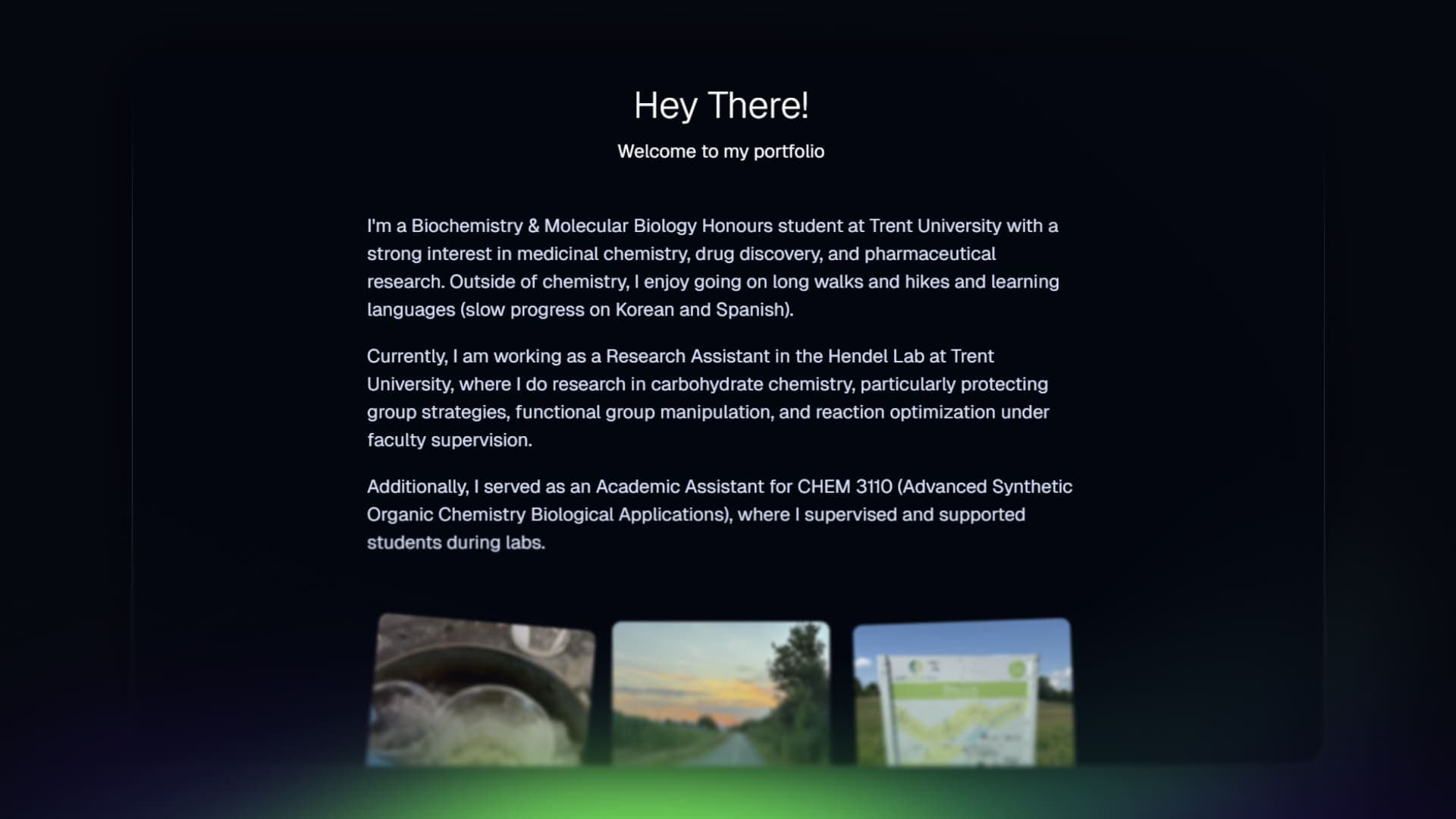
For example:
- My portfolio helps me stand out far more than a résumé ever could.
- I’ve adapted scripts and tools to save time — like using GitHub tools to open notoriously tricky .bkn files for assignments.
- I’ve tweaked molecular modeling software to unlock specific rendering features for presentations.
These small things often make a real difference — saving time, solving niche problems, and making my work more polished.
The competitive advantage
Even though I don’t plan to go into computational chemistry, having some coding knowledge helps me work with modeling programs, scripts, and tools when needed. It’s not about becoming a programmer — it’s about being flexible and resourceful.
“I don’t love coding or math in a classroom setting, but having both in my toolkit gives me an edge.”—Devraj
Do you have any advice for non-tech students?
Treat coding as a tool, not a career you have to master overnight.
Start with a project that actually matters to you. That makes learning feel less like a chore and more like building something useful. Don’t feel ashamed to use AI — it’s just another tool. And don’t get discouraged if you don’t enjoy coding in a classroom setting. Building something for yourself is a completely different experience.
Even a little coding knowledge can help you present your work better, save time, and open doors you didn’t expect.
How do you envision the future of science?
Coding will definitely become more important for scientists — especially in computational and data-heavy fields. But for lab-based research, it’s more of a “nice to have” than a daily requirement.
Still, even a basic understanding of code gives scientists flexibility and options. You might not need it every day, but when you do, it can make a big difference.
Quickfire Q&A
Don’t kill me 💀


“Dev’s journey is proof that you don’t have to be a programmer to benefit from code. Sometimes it’s just the bridge you need to showcase your work, solve niche problems, and build confidence.”
In a world where science and technology keep converging, being curious — and willing to learn enough to build something useful — is already an advantage.
—Lorant
Design Engineers WeeklyLearn about design, development and business